 CAM · SYDNEY
- Steps
- 5
- Markets
- 4
- Round
- ≈55 s
How to Bet on Traffic: Under, Over, Range and Exact Markets
To bet on traffic you pick a live camera feed, wait for the round window to open, and choose whether the vehicle count will finish Under or Over a line, inside a Range, or on an Exact number. Rounds last about 55 seconds, so stake size matters more than timing.
18+ · ≈55 s rounds, up to ~65 an hour · operator margin applies · availability differs by country

How to bet on traffic in five steps
From lobby to settled bet takes less than a minute once you know the order. This is the order — not the rules of the game, which live in the operator’s help screen, but the sequence of decisions that is actually yours.

Rush Hour and the wider CCTV Game range went live with Stake, Shuffle and Roobet in February 2026. A title can be present at one operator and missing at another in the same country, so check where the game is available before you deposit anywhere new.
The game is filed with the operator’s other casino titles, usually under its own studio name, 155.io. It runs continuously: there is no fixture list and no start time, because a new round opens a few seconds after the last one settles.
Seven fixed cameras — Tokyo, Lyon, Sydney, London, Paris, Bucharest and Bangkok — each in its own time zone. At any hour some are in daylight and some are not. The game names the city, not the junction; the camera angle and what the detection zone registers are things you learn by watching a few rounds.
One round counts the vehicles that cross the marked zone for about 55 seconds. The line is the number the operator posts for that feed at that moment. It moves with the feed: a busy camera at rush hour carries a higher line than the same camera at night.
Under, Over, Range or Exact, then the amount. Confirm before bets close. By then the result hash has already been committed (SHA-256), so the count cannot be altered after the fact. When the window ends the round settles on the machine count, and the next one opens.
Notice which steps involve judgement. One and two are admin, three is preference — a feed you like watching. Only four and five are betting decisions, and five is the one that decides what the game costs you, because it is the only one that repeats roughly 65 times an hour.
Everything below is about those two steps: what the four markets really are, how to size a stake for a 55-second game, how to read a line that changes from feed to feed, and the mistakes that come from treating this like a slot or a sports bet. It is neither. The rule sheet itself — disconnects, round numbering, the verifier — is on the operator’s help screen, not here.
The four markets in detail
Drag the line and tap a market. The green cells are the counts that pay — the narrower the green, the higher the payout and the rarer the win.
Illustration of which counts settle each market. It says nothing about odds: the operator sets payouts so that, over thousands of rounds, it keeps its margin.
Under. Wins if the final count is below the line. With Over it forms the pair of broad markets, the nearest the game has to an even-money bet, and the sensible place to start while you learn how a feed behaves.
Over. Wins if the count is above the line. It feels like the natural pick when the screen is full of cars — but the line was set from that same screen. Busy is priced in; what you are really betting on is busier than usual.
Range. Wins if the count lands inside a band of a few numbers. Narrower than a total, wider than Exact, and priced between them. Suits feeds whose counts cluster tightly round the line.
Exact. Wins on one number only. The highest payout in the game and the lowest hit rate. As a once-in-a-while ticket it is harmless; as a default choice at 65 rounds an hour it is the quickest way through a balance.
Probability and payout move in opposite directions across the four, and the operator’s margin sits on all of them. Rush Hour’s published return is 90.00–92.16% (155.io), which means that whichever market you choose, over a long run of rounds the house keeps roughly the rest. No market is “the good one”; they are four ways of slicing the same distribution, with the price adjusted so the slice does not matter to the operator. Payouts for a given line are shown in the game, not published as a table — check them there.

Stake sizing and round frequency
The thing that decides what traffic betting costs is not the market and not the camera. It is the clock.
- One round
- ≈55 scount window, Rush Hour
- Rounds per hour
- ~65if you bet every one
- One hour
- 60 minfeels like a short session
- Turnover per hour
- ×65your stake, whatever it is
A sports bettor who stakes on a match waits ninety minutes to find out. A traffic bettor who stakes on every round finds out 65 times in the same span. That is the whole financial story of this format. Whatever you think of as “a small stake”, multiply it by 65 and you have the amount that passes through the game in one hour of continuous play — and the operator’s margin is taken from that turnover, not from your deposit.
So size the stake from the hour, not from the round. Decide what an hour of this is worth to you as entertainment, divide by 65, and that is the per-round stake that keeps the game inside the budget. For most people the honest answer is a stake that looks almost trivially small on screen. That is correct; the screen is lying to you about the tempo.
Two consequences follow. First, sit out rounds: nothing requires you to bet on every window, and watching costs nothing. Second, never raise the stake to catch up; a loss on one round says nothing about the next, and scaling up on a fast game turns a bad ten minutes into a bad evening.
Reading the line
Why the number you bet against is different on every feed, and different on the same feed an hour later.
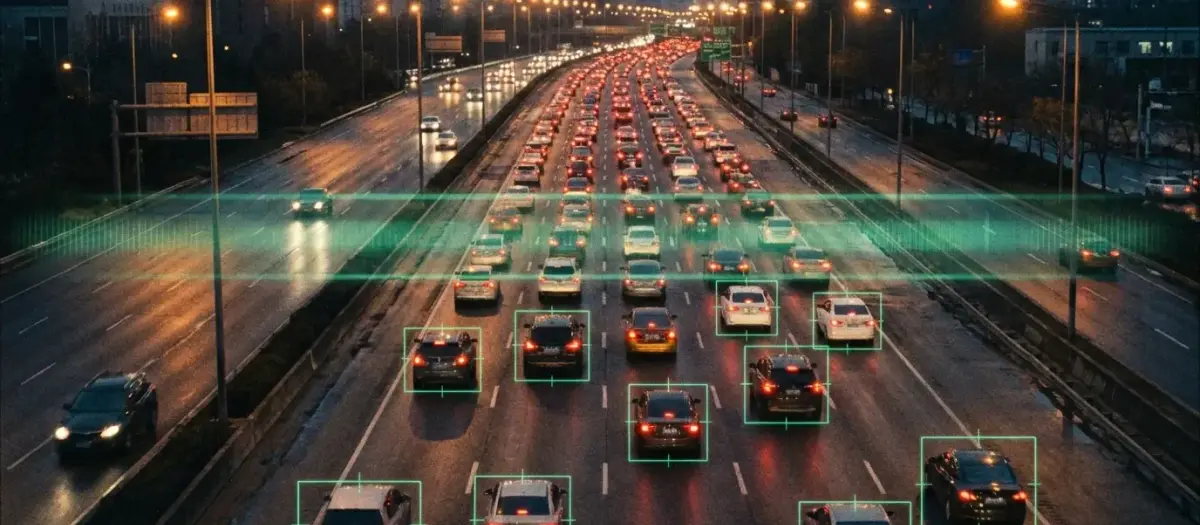
The line is not a fixed property of the game. It is the operator’s estimate of what the detection zone on that particular camera will count in the next ≈55 seconds, and it is recalculated continuously from what the zone has been counting. Three things move it.
The feed. A wide, multi-lane camera produces big counts that scatter; a single-lane feed produces small counts that cluster. The studio does not publish per-camera averages and neither do we, but you can see the difference yourself within a few rounds on Tokyo versus a quieter camera.
The hour, locally. The seven cameras span seven time zones. When it is evening in Europe it is early morning in Sydney, and a feed in its rush hour carries a higher line than the same feed at 3 a.m. Weekday and weekend patterns differ too. That is why the time-zone gap is the one piece of genuinely useful background knowledge in this game — not because it gives you an edge over the line, but because it tells you which feeds will be lively to watch.
The signal upstream. Most cameras look at a junction controlled by lights, so vehicles arrive in waves rather than in a steady flow. A round that starts just as a green phase releases traffic counts differently from one that starts on a red. How much that matters depends on the cycle length at that junction, which is explained on the traffic-light page.
Decides the scale of the count and how widely it spreads round the line.
Rush hour, daytime or night in the camera’s own time zone — not yours.
Waves of traffic, not a trickle. Short windows are sensitive to the phase they start in.
Whatever you noticed, the operator noticed first. The line is where the feed has been, not a guess you can beat.
Common mistakes when betting on traffic cameras
Three ways people lose faster than the margin alone would take them. None of them is about picking the wrong market.
Exact “for luck”, every round
Exact is the highest payout and the lowest hit rate. Played occasionally it is a cheap thrill. Played by default it multiplies the rarest outcome by the fastest cycle in casino gaming — around 65 attempts an hour at the market least likely to land.
Chasing after a run
Three Unders in a row are not “due” to become an Over. Each round is a fresh 55 seconds on a road that does not remember the last one. Raising the stake to recover makes the frequency work against you twice.
Your rush hour, their 3 a.m.
Intuition about heavy traffic belongs to your own city at your own hour. The Bangkok feed at your lunchtime may be in the middle of the night. Check the local clock on the feed before you assume anything about it.
A fourth mistake is quieter: treating a feed you have watched for two minutes as one you understand. Counts vary a lot from round to round, and a quiet spell is often just the red phase of the signal cycle. Watch five or six rounds before staking. It is also why this site publishes no “typical counts” per city: the studio does not, and an invented number is worse than none.
Why there are no betting systems for traffic
You will find pages promising a pattern method for this game. Here is what the pattern sees and what the line actually does.
What pattern thinking sees
- “Counts have been high for ten rounds — the feed is hot.”
- “Five Unders in a row, so Over is overdue.”
- “Every Monday at this hour the Paris feed runs busy.”
- “If I track the last twenty results I can find the rhythm of the lights.”
What the line actually does
- The line is rebuilt from those same ten rounds. A hot feed gets a higher line, not a cheaper Over.
- Rounds are independent windows on a road that has no memory; “overdue” is not a property of traffic.
- If a weekday peak is real, it is in the line before you open the game; the operator has more rounds of data than you ever will.
- The signal cycle shapes the count, but it shapes the operator’s estimate too. Detecting it is not the same as being paid for it.
The honest summary is this. Real traffic is unpredictable rather than patterned: it has structure — rush hours, signal cycles, weekends — but every piece of that structure is visible to the operator, who sets the line from it and then adds a margin. A system would have to find something in the feed that the line does not already contain — and the line is made from the feed. Even a perfect read of the next round would still be paid at odds built to return 90.00–92.16% over time. A system does not change that maths; it only changes how quickly you reach the end of it.
How to bet on traffic — FAQ
How do I place my first traffic bet?
Open the game at an operator that carries it, pick a live feed, wait for the next round window, then choose Under, Over, Range or Exact and confirm your stake.
Which market has the best odds?
Exact pays the most because it lands least often. Under and Over are the closest to even-money style bets, and Range sits between the two.
How many rounds can I play in an hour?
At roughly 55 seconds per round, around 65. That frequency is the main reason small stakes add up quickly in this format.
Is there a strategy that beats it?
No. Real traffic is unpredictable rather than patterned, and the operator margin applies to every round regardless of how you stake.
Do I need to understand traffic to play?
It helps to watch a feed for a few rounds, but local traffic knowledge does not give you an edge over the posted line.
18+The 65-rounds-an-hour rule
Around 65 rounds an hour at roughly 55 seconds each: that frequency, not the camera or the markets, is what makes traffic betting easy to overspend on. Set a deposit limit and a time limit before you open the game, size the stake from the hour rather than the round, and stop when either limit is reached.
- 18+ only. The game is not available in every country; do not try to get around an operator’s restrictions.
- No strategy beats the line. Real traffic owes you no pattern, and the margin applies to every round.
- If it stops being fun, use the operator’s self-exclusion tools — our responsible gambling page lists where to get help.