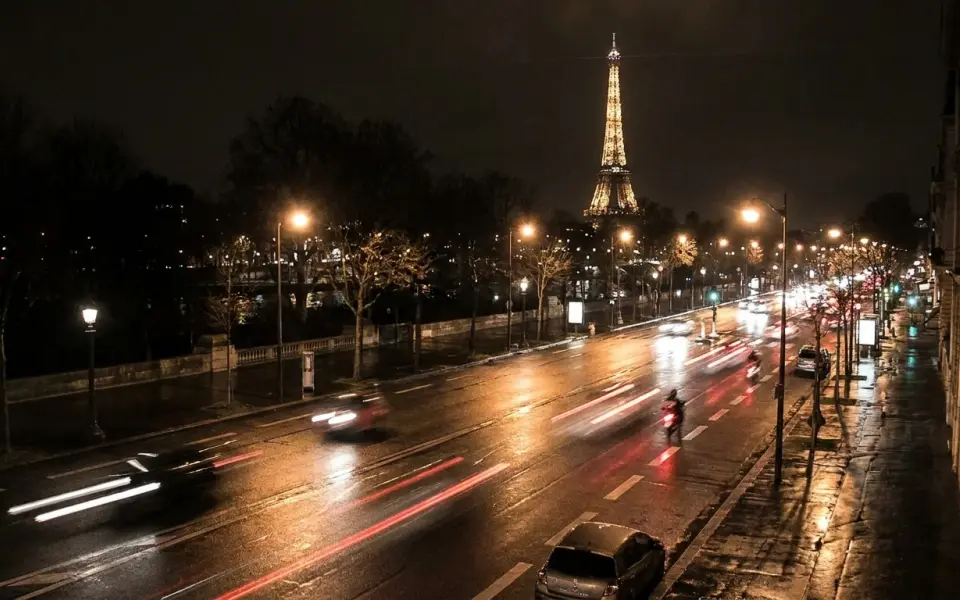
 CAM · PARIS
- Round
- ≈55 s
- Phases
- 3
- Feeds
- 7
Traffic Light Betting: Betting on Red-to-Green Cycles
Traffic light betting means wagering on what a single signal cycle delivers. The light phase sets how long cars flow through the detection zone, which is why cycle length quietly shapes every count you bet on.
18+ · ≈55 s rounds, up to ~65 an hour · operator margin applies · availability differs by country
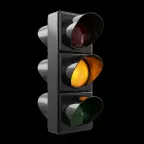
The signal cycle as the round clock
A Rush Hour round is a fixed window of about 55 seconds. The junction upstream of the camera runs its own clock — red, green, amber — and the count you bet on is what happens where the two overlap.
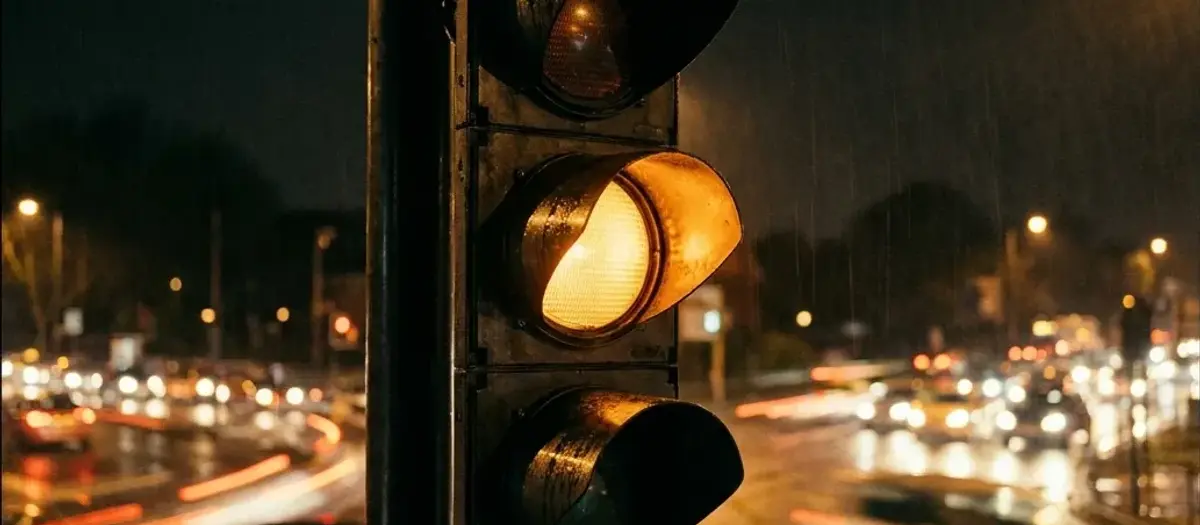
Nobody in Rush Hour bets on a traffic light. The market is always the same: how many vehicles cross the detection zone in the round window — Under, Over, Range or Exact against a line. But on almost any urban camera the flow through that zone is not continuous. Cars arrive in platoons, released by the nearest signal when it turns green and held back when it turns red, and the zone sees a burst, a tail, then near-silence until the next green. Betting on traffic lights, in the only sense that exists, is betting on what those bursts add up to.
The important thing is that the two clocks are independent. The round window opens on the game's schedule, roughly every 55 seconds, around 65 times an hour. The signal cycle runs on the city's schedule. Sometimes a window catches one full green phase; sometimes it opens halfway through a red and closes halfway through the next green, catching the back of one platoon and the front of another. Same camera, same traffic, noticeably different count — and nothing about the road changed.
Why cycle length differs by city
There is no standard traffic light. Cycle length, the share given to each approach and whether the signals are coordinated all vary by road authority — and the seven Rush Hour feeds sit in seven of them.
A signal cycle is the time from one green start to the next on the same approach. On a small crossing it can be well under a minute; on a large multi-arm junction with pedestrian phases and turning lanes it can run to two minutes or more. How much of that cycle is green for the road the camera watches is a second, separate number — a main arterial may hold green for most of the cycle while a side street gets a short slice. Put those two numbers together and you already know a lot about the shape of the count: a long cycle with a long green produces big, widely spaced platoons; a short cycle produces small, frequent ones.
Then there is coordination. Many cities run a green wave along main corridors, timing successive signals so that a platoon released at one junction meets green at the next. A camera on such a corridor sees tidy, regular bursts. Others give priority to public transport, extending or cutting a phase when a bus or tram approaches, which makes the cycle slightly irregular. Which of these applies to the street in front of the Tokyo, London, Paris or Sydney camera is not published by 155.io, and we do not claim to know the junction. What you can see is the result on the feed.
Under a minute to over two
Set by the road authority for the junction. Short cycles give frequent small platoons; long ones give rare large ones. A ≈55 s window may hold one, two or none.
Main road vs side road
The approach the camera watches gets its own slice of the cycle. A long green on an arterial is why some feeds carry a high base count.
Green wave, bus priority
Coordinated corridors make bursts regular; transit priority makes them irregular. Which applies to a given feed: check the picture, it is not published.

Green phase, red phase, and the count
Watch the counter during one round and it does not tick evenly. It sits still, jumps, trickles, sits still again. That unevenness is the signal cycle showing through.
Inside a single round the count is front-loaded or back-loaded depending on where the window opened relative to the cycle. Open on a fresh green and the first fifteen seconds may deliver most of the round's total, followed by a long quiet tail. Open on a red and the counter stays at zero or one for a while, then jumps when the platoon arrives, and the round may close before the burst has fully passed. The final number is the same kind of number in both cases; how it arrived is different.
This is why the spread of a feed — how far its counts scatter from round to round — is often wider than the traffic alone would suggest. Two rounds with identical flow can differ by the size of one platoon simply because one window contained a whole green and the other half of one. On feeds where the zone sits right at a stop line the effect is strongest; on a camera further downstream, where platoons have spread out, the count smooths and the spread narrows. Neither tells you which way the next round goes.
Window opens on a red. One or two stragglers cross; the queue is building upstream, out of the zone.
The released queue crosses as a burst. Most of the round's count lands in these seconds.
Spaced-out vehicles that were not in the queue. Steady trickle, slower than the burst.
A few vehicles clear on amber. Then the zone starts to drain.
Count freezes. The next platoon belongs to the next round.
Illustrative timing of one window over one cycle. Real phase lengths and where the window lands are different on every feed and every round.
Adaptive signals
Not every junction runs a fixed timetable. Where signals respond to traffic, the cycle itself becomes a variable — and the count on the camera inherits that variability.
A fixed-time signal runs the same plan regardless of what is on the road, perhaps switching between a morning, a daytime and a night plan. An adaptive signal uses detectors — loops in the road, cameras, sometimes the same kind of computer vision that counts for the game — to stretch a green while traffic is still arriving, cut it short when the approach empties, or skip a phase nobody is waiting for. Large cities have run such systems for decades, in many variants; we describe the general mechanism only and make no claim about which system controls the street in front of any particular Rush Hour camera.
The consequence for a bettor is straightforward. On a fixed-cycle junction the platoon pattern repeats, so the round-to-round spread comes mainly from where the window lands. On an adaptive junction the platoon size and spacing change too, so counts fluctuate more and the recent average is a weaker guide. The operator sees this in the same counts you do and sets the line from them; you are not discovering anything the price has missed. If a feed's counter seems to land anywhere from three to fourteen across a handful of rounds, an adaptive or irregular junction upstream is one plausible reason — and a reason to be careful with narrow markets, not a reason to expect the next round to revert.
Fixed-time signals
- Same cycle plan all day, or a few plans by time of day.
- Platoons are regular in size and spacing.
- Round spread comes mostly from where the ≈55 s window lands on the cycle.
- Recent counts describe the feed reasonably well.
Adaptive signals
- Green extended, cut or skipped according to detected demand.
- Platoons vary in size and spacing from cycle to cycle.
- Window position and cycle variability both move the count.
- Recent counts are a weaker guide; Exact gets harder, the line already knows.
What this does and does not tell you
Understanding the cycle explains why a feed's counts scatter the way they do. It does not move you to the right side of the line.
What it does: it tells you why two rounds on a calm street can differ by a whole platoon, why some feeds cluster tightly and others scatter, and why a camera that looks quiet at the moment you open the game may post a count well above what you expected ten seconds later. That is useful calibration. It stops you from mistaking a burst for a busy street, or a red phase for an empty one, and it makes the line less surprising when you read it — the same calibration the camera page gives you for angle and lane count.
What it does not do: give you an edge. You cannot see the signal's timetable, you cannot choose when the window opens, and the round begins on the game's clock, not on the light's — so there is nothing to time. The line is set from the feed's own counts, which already contain every platoon that ever crossed that zone, and the margin applies whichever way the next cycle falls. Rush Hour's published return of 90.00–92.16% is the honest statement of that. Real traffic owes you no pattern; a signal cycle is a rhythm, not a forecast.
Illustrative only — a sketch of how unevenly a count can arrive inside one window, not measured data from any feed.
Traffic light betting — FAQ
Are you betting on the lights themselves?
Not directly. You bet on how many vehicles cross the zone, and the light cycle is what governs when they cross.
Does a longer green phase mean a higher count?
Usually yes, all else equal, which is one reason typical counts differ from feed to feed.
Do adaptive traffic lights change the game?
Where signals adapt to load, phase lengths vary, so counts fluctuate more than on fixed-cycle junctions.
Can I time my bet to the light?
The round window opens on its own schedule, not on the signal, so there is nothing to time.
18+The cycle never stops — you have to
Signals run all night and so does the game: a round opens roughly every 55 seconds, around 65 an hour, each one priced with a margin. That frequency is the real risk of this format. Set a deposit limit and a time limit before you open the game, treat every stake as spent, and stop when either limit is reached.
- 18+ only. The game is not available in every country; do not try to get around an operator’s restrictions.
- No strategy beats the line. Real traffic owes you no pattern, and the margin applies to every round.
- If it stops being fun, use the operator’s self-exclusion tools — our responsible gambling page lists where to get help.