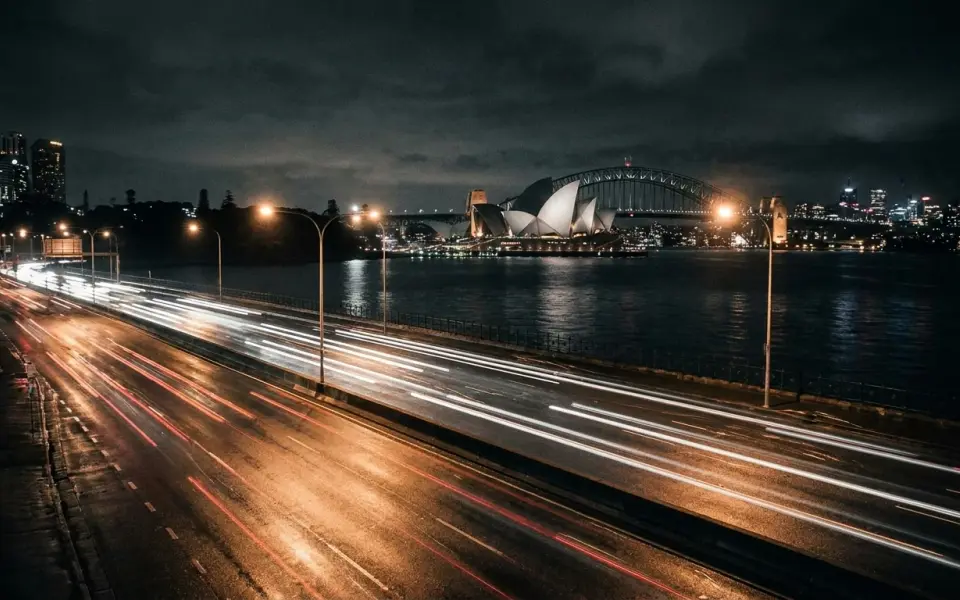
 CAM · SYDNEY
- Time zone
- UTC+10 / +11
- Rush hours local
- 06:30–09:30 · 15:30–18:30
- Round
- ≈55 s
Sydney Traffic Betting: The Feed That Runs While Europe Sleeps
The Sydney feed is one of the live cameras behind Rush Hour. This page covers what the camera shows, when local traffic peaks, and how that lines up with your own time zone — so you know whether the feed is busy or empty before you open it. Sydney's reason to exist on this site is simple: it is in its working day while Europe is in the middle of the night.
18+ · ≈55 s rounds, up to ~65 an hour · operator margin applies · availability differs by country

The Sydney feed itself
One fixed camera over an Australian arterial road, counting whatever crosses a marked zone for about 55 seconds at a time. Its location is not published; its clock is what makes it useful.
Like every Rush Hour camera, the Sydney feed is a static, elevated shot with a detection zone drawn over the lanes. The game lists the city as Sydney and nothing more precise; the junction you are looking at is the one on screen, and we are not going to name one we cannot confirm. The computer-vision model counts objects crossing the zone during the ≈55-second window, the result settles Under, Over, Range and Exact at once, and the next round opens — around 65 rounds an hour.
What distinguishes the Sydney picture is less what is in the frame than when it is full. Sydney is a car-dependent city by European standards: a large share of commuting happens by road, the metropolitan area is spread over a wide basin, and its main arterials carry heavy, directional flows — inbound in the morning, outbound in the evening. A camera on one of those roads shows lanes that fill and drain by direction rather than all at once, which is worth remembering when you look at where the zone sits in the overlay.
The mix leans toward cars, SUVs and utes, with buses on the main corridors — see what gets counted. General mechanics: how a traffic camera makes the count.
The angle does not change between rounds. Which lanes fall inside the zone is visible in the overlay.
A SHA-256 hash of the result is published before the window starts, so the count cannot be edited afterwards.
Directional flow means one side of the road may be releasing while the other is nearly empty.
All four markets settle on the same number. A few seconds later the feed runs again.
Sydney's day starts early
Australian cities keep earlier hours than European ones. That shifts every peak forward — and, combined with the time zone, is what puts Sydney's traffic in Europe's night.
Sydney's working day begins early by European standards. Tradespeople are on the road before dawn, school starts around 09:00, and office hours commonly run 08:30 to 17:00. The result is a morning peak that builds from about 06:30 and is largely over by 09:30, and an afternoon peak that starts around 15:00 with the school pick-up, merges into the commute and fades by 18:30. By 20:00 a typical arterial is quiet; by midnight it is close to empty apart from freight and taxis.
Saturday mornings are busy with sport and shopping, and on warm days the roads toward the coast fill from late morning. Sundays and public holidays are the quietest. Sydney drives on the left, and its major junctions use adaptive signal control, so phase lengths vary with demand — see the signal-cycle page.
Morning inbound
Early, directional and sharp. Inbound lanes carry most of it; the opposite direction can look half-empty on the same camera.
Daytime plateau
Steady commercial and local traffic. Moderate counts with smaller swings than either peak.
School run into the commute
Starts with the 15:00 school pick-up, then the office exodus. Outbound lanes dominate.
Quiet early
Sydney is not a late city on weeknights. Counts drop and become erratic; a round can pass with very little crossing the zone.

Time zone: when this feed is busy
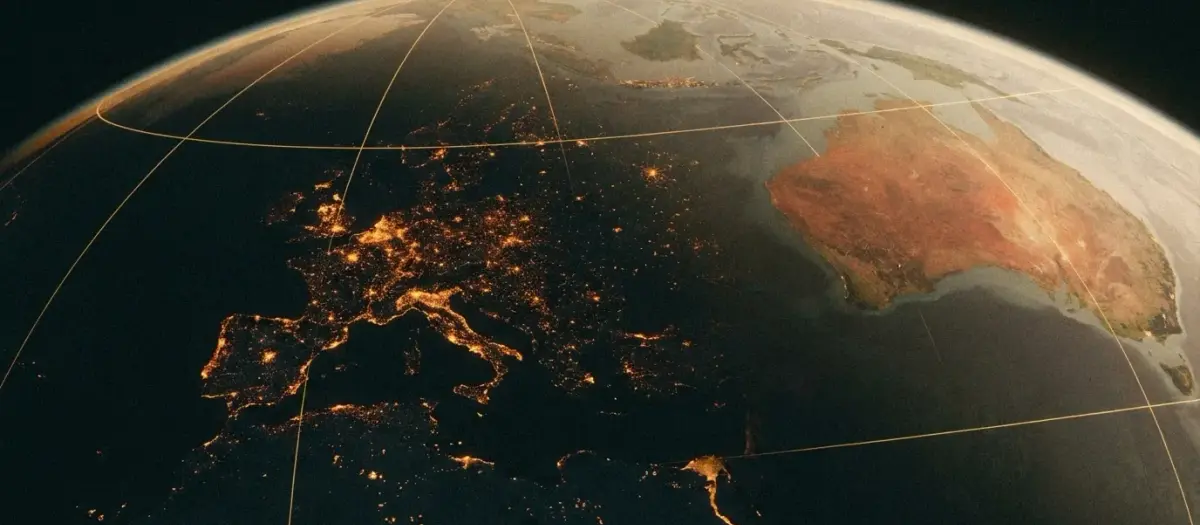
This is the chapter the page exists for. Sydney is UTC+10 in the southern winter and UTC+11 in its summer — eight to ten hours ahead of Central Europe. Its working day is Europe's night.
Rush-hour bands (07–10, 16–19 local, Mon–Fri) are the typical big-city pattern, not a measurement of the feed. Hover or tap a cell to read it.
- Morning rush · Sydney
- 06:30–09:30local, Mon–Fri
- = UTC
- 20:30–23:30previous day (AEST); 19:30–22:30 in AEDT
- = Central Europe
- 22:30–01:30CEST now; shifts by an hour twice a year
- = US Eastern
- 16:30–19:30EDT, previous day; shifts with both clocks
- Afternoon rush · Sydney
- 15:30–18:30local, Mon–Fri
- = UTC
- 05:30–08:30same day (AEST); 04:30–07:30 in AEDT
- = Central Europe
- 07:30–10:30CEST now; shifts by an hour twice a year
- = US Eastern
- 01:30–04:30EDT; shifts with both clocks
Sydney is the awkward one for conversions, because both ends move their clocks — and in opposite seasons. Sydney observes daylight saving from the first Sunday in October to the first Sunday in April, going to UTC+11 exactly when Europe and North America fall back. So the gap to Central Europe is 8 hours in the European summer and 10 hours in the European winter; the cards above show the summer figures and the grid is always live. Treat any fixed conversion as “give or take an hour” depending on the date.
The practical reading: when a European opens the game at 23:00, London and Paris are in their quietest hours and Sydney is in its morning rush; at 08:00 CET Sydney is in its afternoon peak; in between it sits on its daytime plateau alongside Tokyo. For the European night those two cameras show real traffic — the empty-frame problem is on what “live” means for the count.
What gets counted on the Sydney feed
The model counts objects crossing the zone according to that feed's configuration. The configuration is not published, so this is what to check, not what to assume.

The bulk of the frame
Sydney's traffic is dominated by private vehicles. A pickup or an SUV is one object like a hatchback; what matters is whether it crosses the zone, not how large it is.
Check the game
Main arterials carry buses and freight. In most configurations each is a single count, but whether this feed treats them differently is not stated anywhere we can cite.
Smaller share, same question
Two-wheelers are a modest part of Sydney traffic. The game decides whether they register; we have not seen a per-feed rule published by 155.io.
Sydney's directional arterials raise one question the other feeds do not: does the zone cover one direction or both? If it sits across inbound lanes only, the morning peak pushes counts up and the afternoon peak barely registers — and vice versa. That is visible in the overlay in thirty seconds.
Typical counts and spread on Sydney
Not published — and more variable across the day than on a denser feed, because Sydney's quiet hours are genuinely quiet.
- Typical count
- Not publishedno per-feed statistics from 155.io
- Day vs night
- Large gapqualitative: early city, quiet evenings
- Window
- ≈55 sabout 65 rounds an hour
- Return (155.io)
- 90.00–92.16%same on every feed
155.io publishes no average count, line or variance for Sydney or any other camera, and we will not fabricate one. Qualitatively, the gap between a Sydney peak and a Sydney midnight is large because the city empties early: the line moves a long way across the day, counts cluster tightly at night and scatter at the peaks.
A high morning line is not an invitation to bet Over, and a low midnight line is not an invitation to bet Under — both come from the feed with the same margin. Read how the four markets settle before staking; the hub at bet on traffic explains why “unpredictable” is not “exploitable”.
Other feeds
When Sydney's evening goes quiet, Europe is waking up. London and Paris are the next two cameras on the ring.
 CAM · LONDON
 CAM · PARIS
All seven cities with live clocks are on the home page. Which operators carry the game is on where it is available.
Sydney traffic betting — FAQ
Where exactly is the Sydney camera?
The game lists Sydney as a feed; the precise junction is what you see on screen. 155.io does not publish camera addresses, so we describe the view — a fixed, elevated angle over a multi-lane road — rather than guessing a suburb or a street.
When is the Sydney feed busiest?
Sydney's weekday peaks start early: roughly 06:30–09:30 and 15:30–18:30 local time, which in winter (AEST, UTC+10) is 20:30–23:30 and 05:30–08:30 UTC. The table above converts them into your own clock. For Central Europe that is late evening and early morning — the hours when the Paris and London feeds are empty.
Does the Sydney feed count motorbikes?
Detection settings vary by feed, so check what the game states for this camera before assuming. Sydney's two-wheeler share is modest compared with Tokyo or Paris, so the question matters less here — but the configuration itself is not published.
Is Sydney better to bet on than other feeds?
No feed is better value than another; the line moves with the feed and the margin is the same everywhere. What Sydney offers is timing: it is in daytime while Europe is in the night, so its counts are meaningful when the European cameras are showing empty lanes. That is a reason to watch it, not a reason to expect a better price.
18+Play it like a 55-second game
A round ends, the next one opens, and an hour can hold around 65 of them. That frequency — not the camera, not the markets — is what makes this format easy to overspend on. Set a deposit limit and a time limit before you open the game, treat every stake as money spent, and stop when either limit is reached.
- 18+ only. The game is not available in every country; do not try to get around an operator’s restrictions.
- No strategy beats the line. Real traffic owes you no pattern, and the margin applies to every round.
- If it stops being fun, use the operator’s self-exclusion tools — our responsible gambling page lists where to get help.