 CAM · TOKYO
- Round
- ≈55 s
- Feeds
- 7
- Counted by
- AI
Bet on Traffic Cameras: How AI Counts Cars on Live Feeds
Traffic camera betting settles on a machine count, not a human one. Computer vision draws a detection zone over the live feed and registers every object that crosses it, which is why camera angle, lane count and weather matter more than intuition about traffic.
18+ · ≈55 s rounds, up to ~65 an hour · operator margin applies · availability differs by country
How object detection works on a traffic camera
Between a car entering the frame and your count going up by one, the model finds it, follows it, and logs the instant it crosses a line you can see.
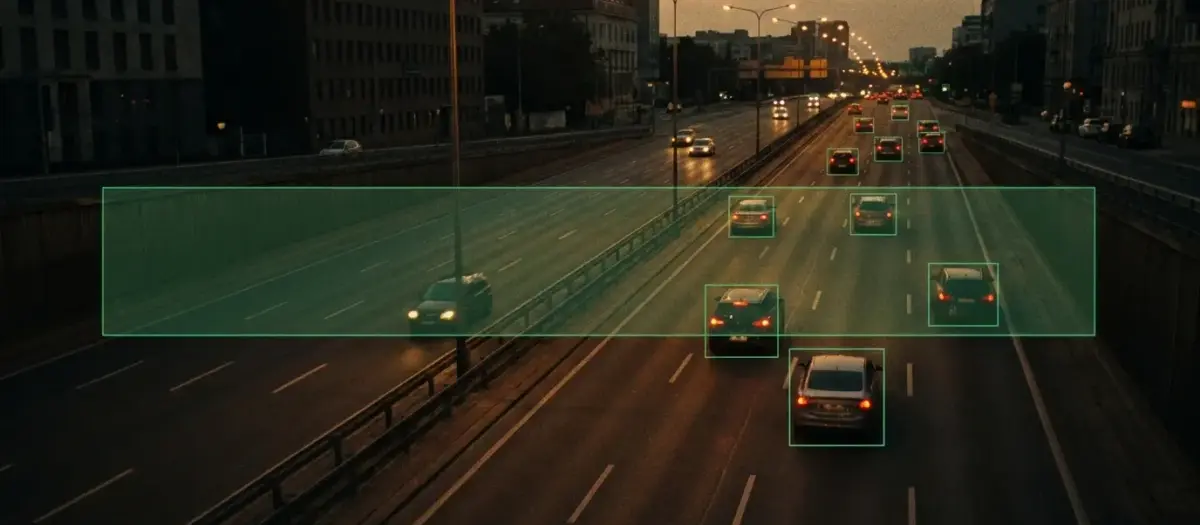
When you bet on traffic cameras in Rush Hour, the footage is half of the product; the other half is a computer-vision model running on top of it. Every frame is scanned for things that look like vehicles, and each one gets a box and an identity, so the same car in frame 1 and frame 30 is one object, not thirty. That second step, tracking, stops a slow van being counted five times while it crawls through the shot.
The count itself is tied to a detection zone — a marked area drawn over one or more lanes, fixed for that camera. An object is registered at the moment its tracked position crosses into the zone — not when it enters the frame, not when it leaves. That is why the studio describes the game as counting "objects passing through a detection zone", not "cars in the picture": a vehicle that turns off before the zone contributes nothing.
Everything is stamped against the round clock: a Rush Hour round runs about 55 seconds, and only crossings inside the window count. Before bets close a SHA-256 hash of the result is published, so the number you are paid on is the number the model produced — nobody edits it afterwards. What the hash cannot tell you is how good the model was at its job; the rest of this page is about that.
Each frame is scanned; anything the model classifies as a vehicle gets a box. Low-confidence blobs in fog or deep shadow may get nothing.
The same car keeps the same ID as it moves. Lose the track — say behind a bus — and the model has to decide whether what reappears is new or the same.
One event per tracked object entering the detection zone. This is the only moment that adds to the count.
Inside the ≈55 s window it counts. On the boundary it goes to whichever round the clock says.
The final number is revealed against the SHA-256 hash published before bets closed, then Under, Over, Range and Exact are paid.
What the camera counts — and what it may not
The honest answer is that it depends on how detection is configured for each feed, and 155.io does not publish a per-camera list. Here is what that means for each kind of road user.
Computer-vision models used for traffic are trained on object classes — car, truck, bus, motorcycle, bicycle, person and so on. Which of those classes a given Rush Hour feed turns into a count is a configuration choice, and the studio's public material talks about "vehicles" and "objects" without breaking it down city by city. So the correct way to bet on traffic cams is to treat the class list as unknown until the game tells you, not to assume "cars only" because that is what the word "traffic" brings to mind.
It matters: a feed with heavy two-wheeler traffic behaves very differently depending on whether scooters are in or out, and the line for that camera is set on whatever the model actually registers — the operator knows, you are guessing. The cards map the question, not the answer: read what the game states for the camera you are watching, and if it states nothing, treat it as not published.
The core class
Passenger cars and light vans are what every traffic model is best at and what the marketing footage shows crossing the zone. Safe to assume these are counted on every feed.
Large, slow, and they hide others
Usually detected as vehicles, but a long bus in the zone blocks the lane behind it for a second or two — the cars it hides are the ones most likely to be missed.
Depends on feed configuration
Motorbikes, scooters and bicycles are separate classes. Whether they add to the count is not published per city; check in the game for the camera you are on.
A separate class, normally outside the zone
Detection zones sit on the carriageway, and nothing public suggests people are counted on a traffic feed. Treat it as not counted unless the game says otherwise.

Why the angle changes the numbers
Two cameras can watch identical traffic and produce systematically different counts. The viewpoint is the variable.
The first driver is the obvious one: lane count. A detection zone drawn across four lanes of a boulevard sees four streams of vehicles in parallel; a zone across a single lane sees one. Over a 55-second window that is the difference between dozens and single digits — and why the line on one feed is not comparable to the line on another. The Tokyo feed and the Paris feed are not "busier" or "quieter" in some absolute sense; they are different geometries.
The second driver is occlusion. From a low, oblique angle, a bus in the nearest lane covers the cars behind it. If a car crosses the zone while hidden, the model never sees it and the count is one short. From a high, steep angle vehicles barely overlap and almost every crossing is visible. Neither is wrong — but the low angle under-counts dense traffic consistently, and the line for that camera already reflects it.
The third is distance: far from the lens two cars nose-to-tail can merge into one box and one crossing. Put the three together and you get the practical rule: a feed has a characteristic count and spread, and both belong to the camera, not to the city.
Wide, multi-lane, low angle
- Several parallel streams cross the zone at once; base count is high.
- Heavy occlusion: buses and trucks hide the lane behind them.
- Counts scatter widely from round to round — a big spread.
- Under-counting in dense traffic is consistent, so the line is set on the under-counted number.
Narrow, single-lane, steep angle
- One stream; base count is low and arrives in the rhythm of the upstream signal.
- Little occlusion: vehicles hardly overlap from above.
- Counts cluster tightly around the line — a small spread.
- Closer to "every car that passed" — and the line knows that too.
Weather, night and glare
Same camera, same street, different hour — and the model works from a different picture. We describe the mechanisms; how a particular feed behaves is something to check, not assume.
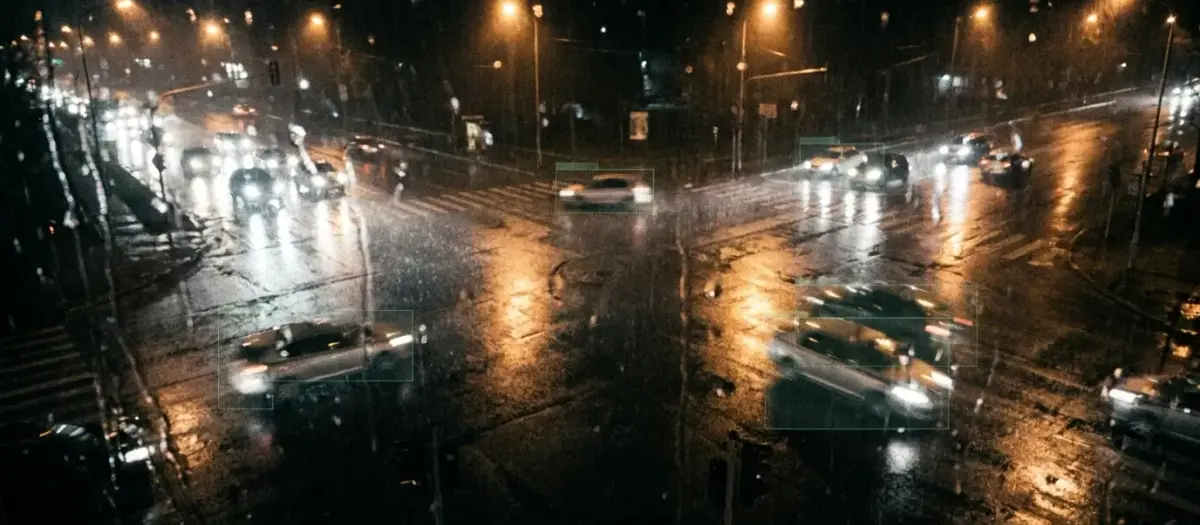
Detection quality depends on contrast between a vehicle and its background. In daylight that contrast is generous. At night the vehicle itself largely disappears and the model is left with headlights, tail-lights and whatever the street lighting shows. Traffic models cope, but with less information, and the two failure modes are: a pair of headlights can be read as one object where there were two, or a bright reflection can briefly look like an object where there was none.
Rain adds a second layer: wet asphalt mirrors every light source and drops on the housing soften the image. Glare — low sun into the lens, or high beams on a dark road — can wash out a band of the frame for a few seconds, during which nothing there is tracked. Fog and snow shrink the detectable distance.
How the Rush Hour model handles each of these on each feed is not published by 155.io, and we will not invent it. What you can do is watch the footage: if the 2 a.m. picture on the London feed is a dark road with streaks of light, the count comes out of that picture, and its spread is not the daytime spread. The live-traffic page covers what "live" actually guarantees you in those conditions.
Mechanisms are generic to camera-based detection. Per-feed behaviour is not published by the studio.
Camera betting vs sports betting totals
Under and Over on a traffic camera look exactly like a totals market on a football match. The resemblance is useful for about two minutes, and then it starts to mislead.
Where the analogy holds: there is a line, you pick a side, the operator prices both with a margin, and one number settles everything. Anyone who has bet a total reads Under and Over on sight; Range and Exact are narrower bands on the same axis. "The line is the operator's estimate of the middle" carries over intact.
Where it breaks: a totals bettor can know something the line does not — an injury, a forecast the market has not absorbed. On a traffic camera there is nothing of the kind. The line comes from the camera's own recent counts, the round opens every ≈55 seconds, and your only private input is your impression of a picture the model reads far better than you. A football total is one researchable event; a traffic total is one of roughly 65 an hour that nobody can research.
One event, researched
Hours or days between markets. Public information, form, conditions. Your edge, if any, is knowing more than the line.
Same market shape
A line, two sides, a margin, a single settling number. Under and Over behave identically; Range and Exact are tighter slices of the same axis.
65 events an hour, unresearchable
The line is built from the feed itself. There is no private information and no time to use it. The margin is paid on every round.
Reading a feed before you bet
Not a system — there is none. Just the two or three minutes of watching that tell you what kind of camera you are looking at.
Locate the detection area on the picture and count the lanes it covers. That alone tells you whether to expect single digits or dozens.
Note the final count each time. This is the camera's base level right now, at this hour, in this weather.
Did the two rounds land close together or far apart? Tight feeds suit narrow markets; scattered feeds make Exact a long shot.
In bursts or a steady trickle? Bursts mean an upstream signal is releasing waves — see how the light cycle shapes a round.
The line should sit near what you just saw. If it does, the operator and you agree on the feed; there is no further edge to find. Stake accordingly, or not at all.
This is calibration, not prediction. Knowing a feed's base level and spread stops you taking an Exact on a four-lane boulevard because the number "looked about right". It does not tell you which side of the line the next 55 seconds will fall on; real traffic owes you no pattern, and the margin applies regardless. If you are new to the game, the step-by-step on how to bet on traffic covers markets and stakes, and where the game is available lists the operators carrying it since February 2026. For the broader picture of the format, start at the overview of betting on traffic.
Betting on traffic cameras — FAQ
How does the game count vehicles?
A computer vision model tracks moving objects and registers each one that crosses a predefined detection zone in the camera's field of view.
Does it count motorbikes and bicycles?
That depends on how the detection is configured for each feed. Check what the game states for the camera you are watching rather than assuming cars only.
Can bad weather change the result?
Rain, darkness and headlight glare all affect how cleanly a camera separates objects, so counts on the same feed can behave differently at night than in daylight.
Are some cameras better to bet on?
Feeds differ in lane count and angle, which shifts the typical count and its spread. Watching a few rounds before betting tells you more than any general rule.
Can I verify the count myself?
You can watch the same footage the count is taken from, which is the point of the format. What you cannot audit is the detection model itself.
18+A camera never closes — you have to
A traffic feed runs all day and a round opens roughly every 55 seconds, which is around 65 chances an hour to stake on a number you cannot predict. That frequency, not the camera, is the risk of this format. Set a deposit limit and a time limit before you open the game, treat every stake as spent, and stop when either limit is reached.
- 18+ only. The game is not available in every country; do not try to get around an operator’s restrictions.
- No strategy beats the line. Real traffic owes you no pattern, and the margin applies to every round.
- If it stops being fun, use the operator’s self-exclusion tools — our responsible gambling page lists where to get help.