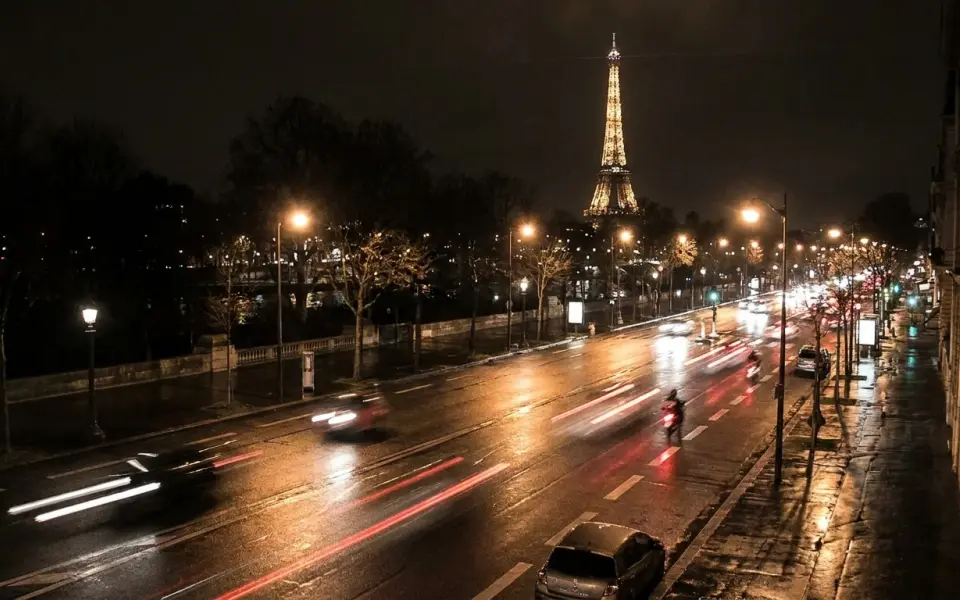
 CAM · PARIS
- Time zone
- UTC+1 / +2
- Rush hours local
- 07:30–09:30 · 17–19:30
- Round
- ≈55 s
Paris Traffic Betting: How the French Feed Behaves
The Paris feed is one of the live cameras behind Rush Hour. This page covers what the camera shows, when local traffic peaks, and how that lines up with your own time zone — so you know whether the feed is busy or empty before you open it. Paris is the two-wheeler city of the lineup, which makes “what counts?” the first question here rather than an afterthought.
18+ · ≈55 s rounds, up to ~65 an hour · operator margin applies · availability differs by country

The Paris feed itself
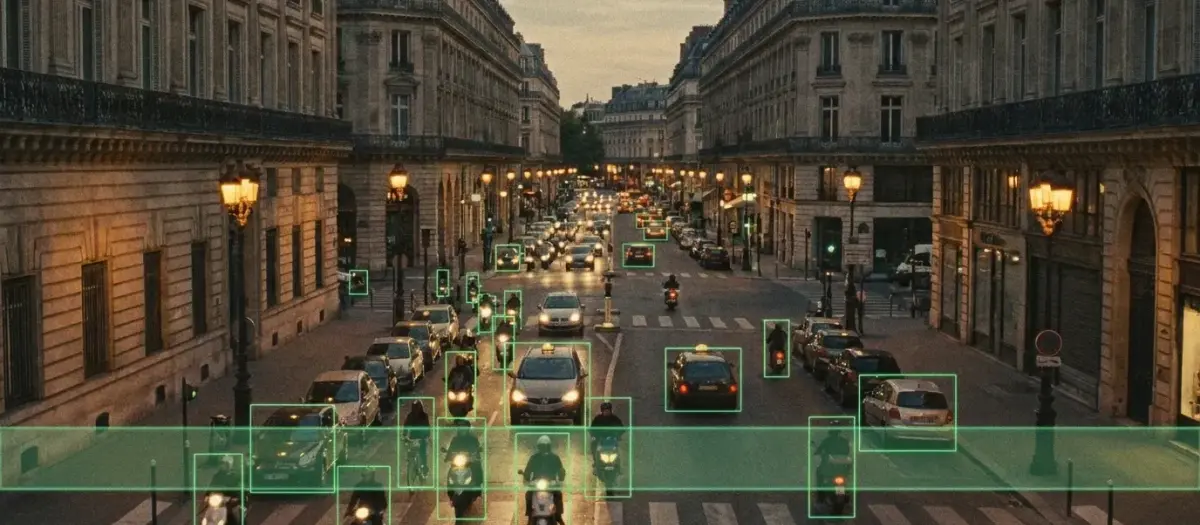
A fixed camera over a wide Parisian road, a detection zone across the lanes, and a stream of traffic in which a good part of what moves has two wheels. Location not published; character obvious.
Rush Hour labels this camera Paris and nothing more specific. The exact junction is what you see on screen; we describe the view, not an address. Mechanically it is the same as every other feed: a static, elevated angle, a marked detection zone, a computer-vision model registering objects as they cross it, a ≈55-second window, and one settled count that pays all four markets — about 65 rounds an hour.
What makes a Paris frame look like Paris is the width of the road and the mix on it. The city's main axes are wide, multi-lane boulevards, often with a bus lane and, since the cycling build-out of 2020 onwards, a protected bike lane alongside. On those lanes, cars share space with an unusually high density of scooters and motorbikes — filtering to the front at a red light, then pulling away as a pack when it turns green — plus a growing volume of bicycles and the occasional bus. The result is a release that happens in two waves: the two-wheelers first, the cars behind them.
Whether the model registers that first wave is covered under what gets counted; general mechanics are on how a traffic camera makes the count.
Filtering is routine in Paris. By the end of a red phase, the first metres at the stop line are mostly scooters and bikes.
If the zone is near the stop line and the model counts them, this wave is a burst of small objects in a few seconds.
The part of the release every configuration counts. Wider lanes mean several abreast.
Which is why the count scatters — and why the line already assumes it does.
How Paris moves through a day — and a year
Public, well-known facts about the city, not a measurement of this camera. Paris has sharp peaks, a 30 km/h limit on most streets, and one month a year when it half-empties.
Paris's weekday rhythm is a conventional European one with a late start: the morning peak builds from about 07:30 and is over by 09:30; the evening peak runs from about 17:00 to 19:30 and is broader than the morning. Between them, daytime traffic is moderate and mixed — deliveries, taxis, buses and the constant two-wheeler background. Since 2021 most Paris streets carry a 30 km/h speed limit, with the main boulevards and the ring road among the exceptions, so even free-flowing traffic moves slowly; the ring road itself dropped to 50 km/h in late 2024.
Evenings are livelier than in Sydney or London — the boulevards keep moving until around midnight. Sundays are quiet. Then there is August: Paris empties for les grandes vacances, the peaks flatten and a weekday can look like a weekend. Paris drives on the right; its signal-controlled junctions are covered on how the signal cycle shapes the count.
Morning peak
Sharp and short. Two-wheelers are at their densest here — commuters on scooters beat the queues, and cyclists are out in force.
Mixed daytime
Moderate flow with a steady two-wheeler background. Deliveries and buses; counts with smaller swings than at the peaks.
Evening peak
Broader than the morning and slower to clear. Friday evenings in summer can run late into the night.
The empty month
Peaks flatten, lines drop. A weekday camera in mid-August can look like a Sunday in May.

Time zone: when this feed is busy
Paris is Central European Time — UTC+1 in winter, UTC+2 in summer. For most of Europe it is simply “local”; for everyone else it is the benchmark the other feeds are measured against.

Rush-hour bands (07–10, 16–19 local, Mon–Fri) are the typical big-city pattern, not a measurement of the feed. Hover or tap a cell to read it.
- Morning rush · Paris
- 07:30–09:30local, Mon–Fri
- = UTC
- 05:30–07:30CEST; 06:30–08:30 in winter (CET)
- = Central Europe
- 07:30–09:30Paris is CET — no conversion
- = US Eastern
- 01:30–03:30EDT; can differ by an hour for a few weeks in spring and autumn
- Evening rush · Paris
- 17:00–19:30local, Mon–Fri
- = UTC
- 15:00–17:30CEST; 16:00–18:30 in winter (CET)
- = Central Europe
- 17:00–19:30no conversion
- = US Eastern
- 11:00–13:30EDT; shifts by an hour in winter for both sides
For Central Europe the grid is trivial: Paris is busy when your own street is. The useful part is the inverse — knowing when Paris is empty. Its quiet hours, roughly 01:00 to 06:00 local, are exactly when Tokyo (UTC+9) and Sydney (UTC+10 or +11) are in their morning and daytime; the Paris camera and the Asia-Pacific cameras are almost never busy at the same time.
For the Americas, Paris's evening rush is lunchtime Eastern; its morning rush is the middle of the night. The London feed runs one hour behind all year and is still in its evening peak when Paris tails off. Summer and winter time shift every figure by an hour; the grid is live, so trust it near a clock change.
What gets counted on the Paris feed
On most feeds this is a footnote. On Paris it is the main event: a large share of what crosses any junction here has two wheels, and whether the model counts it changes the whole number.
Always in
The baseline every detection zone is built for. On a wide boulevard they cross several abreast, so a single green release can add many in a few seconds.
The key question
Paris has one of the highest motorised two-wheeler shares of any European capital. Whether this feed counts them is not published by 155.io — check what the game states for this camera before assuming either way.
Lane matters
Cycling has grown sharply since 2020 and most big axes now have a protected lane. If that lane is outside the zone, bikes are irrelevant; if it is inside, the configuration decides.
On a busy morning the two-wheelers at the front of a queue can outnumber the first row of cars, so a configuration that counts them and one that ignores them produce very different numbers from the same green light — and neither is wrong, because the line is built from whichever rule is in force. Look at the overlay, watch a round or two, and see whether the count jumps when the scooters cross.
Typical counts and spread on Paris
Not published. What a viewer can say: wide lanes plus a two-wave release make Paris a feed where rounds can differ a lot from one another.
- Typical count
- Not publishedno per-feed statistics from 155.io
- Spread
- Widequalitative: wide lanes, two-wave releases
- Seasonal
- August dipcity empties for the holidays
- Return (155.io)
- 90.00–92.16%same margin on every feed
155.io publishes no typical count, average line or variance for Paris, and we have not logged enough rounds to quote one. Qualitatively, wide lanes plus the two-wave release mean a ≈55-second window can land on a near-empty road or a double burst, so counts scatter. In August and at night the same camera produces small, tightly clustered numbers and a low line.
None of that is a strategy. A wide spread makes Exact land less often, and the payout already reflects it; the margin sits inside every market however busy the boulevard looks. Market mechanics: how to bet on traffic; why “real world” is not “fair value”: the bet on traffic hub.
Other feeds
When Paris goes to bed, Tokyo and Sydney are getting up. They are the next two cameras on the ring and the ones to watch overnight.
 CAM · TOKYO
 CAM · SYDNEY
All seven cities with live clocks are on the home page. Which operators carry the game, with check dates, is on where it is available.
Paris traffic betting — FAQ
Where exactly is the Paris camera?
The game lists Paris as a feed; the precise junction is what you see on screen. 155.io does not publish camera locations, so we describe the view — a fixed, elevated angle over a wide multi-lane road with a lot of two-wheelers — rather than guessing a boulevard or an arrondissement.
When is the Paris feed busiest?
Paris's weekday peaks run roughly 07:30–09:30 and 17:00–19:30 local time, which in summer (CEST, UTC+2) is 05:30–07:30 and 15:00–17:30 UTC. The table above converts them into your own clock. August is the exception: the city empties for the holidays and the peaks flatten noticeably.
Does the Paris feed count motorbikes?
This is the key question for Paris, where scooters, motorbikes and bicycles are a large share of what crosses any junction. Detection settings vary by feed and 155.io does not publish them per camera, so check what the game states for this feed before assuming two-wheelers are in — or out of — the count.
Is Paris better to bet on than other feeds?
No. A two-wheeler-heavy feed may produce bigger or more scattered counts depending on configuration, but the line is built from that same feed, so whatever the count looks like is already priced in. Busier or more variable means different numbers, not better value; the margin is the same everywhere.
18+Play it like a 55-second game
A round ends, the next one opens, and an hour can hold around 65 of them. That frequency — not the camera, not the markets — is what makes this format easy to overspend on. Set a deposit limit and a time limit before you open the game, treat every stake as money spent, and stop when either limit is reached.
- 18+ only. The game is not available in every country; do not try to get around an operator’s restrictions.
- No strategy beats the line. Real traffic owes you no pattern, and the margin applies to every round.
- If it stops being fun, use the operator’s self-exclusion tools — our responsible gambling page lists where to get help.